
Why should candidates in the West Midlands sign the UKWIN Recycling Pledge?
The Climate Change Committee has warned that “If EfW [incineration] usage is left to grow unchecked” this could result in “undermining recycling and re-use efforts” and has recommended that:
- The Government should: “Publish an assessment of residual waste treatment capacity needs through to 2050, consistent with meeting committed and prospective recycling and waste reduction targets”; and that
- There needs to be: “a moratorium on additional EfW capacity until a review of capacity requirements has been completed and an updated assessment of residual waste treatment capacity requirements published”.
In response to these concerns, UKWIN is calling on candidates in the forthcoming elections to agree with the need to stop building new incineration capacity, and the need to minimise waste incineration by maximising waste reduction, reuse, and recycling.
65%+ recycling target
The current Resources and Waste Strategy for England was published in December 2018 and establishes a target of reaching 65% recycling target for municipal waste (which includes both household and some business waste) by 2035.
According to UK Government statistics, Warwick District Council in the West Midlands achieved a 53.4% recycling rate in 2022/23.
Measures such as expanding the range of material collected at the kerbside, reducing single-use packaging, rolling out food waste collections, and better waste education can help improve recycling rates across the West Midlands.
Wales achieved 66% recycling in 2022/23, with several local authorities achieving 70%+ recycling rates.
Residual waste reduction targets
The Environmental Targets (Residual Waste) (England) Regulations 2023 put into law a statutory target for England to halve residual waste sent to incineration or landfill by 2042 compared to a 2019 base year.
The Environmental Improvement Plan 2023 provides a set of interim targets for 2027, including a target to reduce municipal residual waste produced per person by 29% compared to a 2019 base year.

How opposing new incineration capacity supports recycling and waste reduction
Incinerators are harming recycling by burning recyclable and compostable material.
Many councils told the Government that their low recycling rates are due to incineration contracts undermining their ability to invest in recycling service improvements.
According to UK Government data, there is a link between high rates of incineration and low rates of recycling.

Studies indicate that most of what is currently in the ‘residual’ waste stream is readily recyclable, meaning a significant proportion of what is currently incinerated or landfilled could have been recycled or composted.
A Defra report published in August 2020 stated that: “Of total residual waste from household sources in England in 2017, an estimated 53% could be categorised as readily recyclable, 27% as potentially recyclable, 12% as potentially substitutable and 8% as difficult to either recycle or substitute”.
To support recycling and the circular economy, both Wales and Scotland have banned new incineration capacity.
Incineration in the West Midlands

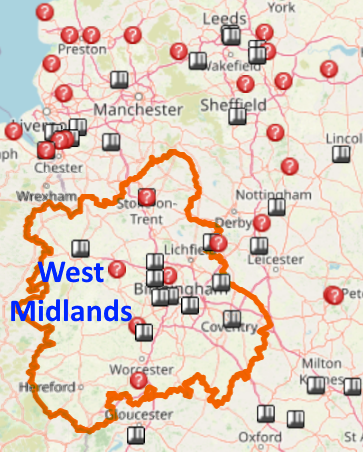
Across England there is already more incineration capacity than genuinely residual waste to burn. The West Midlands has a significant amount of incineration capacity that is operational or under construction, yet there is even more in the pipeline. Limiting incinerator feedstock to genuinely residual waste would free up more than half the current capacity, undermining the rationale for building new incinerators. We must stop building new burners and divert recyclables away from incinerators.
Existing incineration capacity in the West Midlands (currently operational or under construction)
| Incinerator | Operator | Modelled Capacity (tonnes) | Status | Incinerated in 2023 (tonnes) | CO2 emitted in 2023 (tonnes) |
|---|---|---|---|---|---|
| Tyseley (Birmingham), West Midlands Met Districts | Tyseley Waste Disposal Ltd / Veolia | 396,450 | Operational | 362,540 | 409,804 |
| Four Ashes, Staffordshire | Veolia | 306,000 | Operational | 330,761 | 399,741 |
| Coventry, West Midlands Met Districts | The Coventry & Solihull Waste Disposal Company Ltd | 283,500 | Operational | 291,805 | 288,669 |
| Hartlebury, Worcestershire | Mercia EnviRecover (part of FCC and Urbaser) / Mercia Waste Management (MWM) Ltd | 207,000 | Operational | 210,009 | 116,962 |
| Stoke (Hanford), Stoke on Trent | MES Environmental Limited | 189,000 | Operational | 185,042 | 174,310 |
| Baddesley, Warwickshire | Equitix EEEF WTE (Baddesley) Limited, | 117,000 | Operational | 95,838 | 92,131 |
| Wolverhampton, West Midlands Met Districts | MES Environmental Limited | 106,200 | Operational | 98,039 | 92,353 |
| Dudley, West Midlands Met Districts | MES Environmental Limited | 94,500 | Operational | 69,211 | 266,161 |
| Battlefield (Shrewsbury), Shropshire | Veolia | 91,800 | Operational | 91,746 | 113,197 |
| Kelvin (West Bromwich), Sandwell | enfinium / Verus Energy Oak Limited | 360,000 | In Construction | ||
| TOTAL EXISTING | 2,151,450 (of which 1,791,450 is operational) | 1,734,991 | 1,953,328 |
Incineration capacity in development (active projects with planning consent that have yet to enter construction)
| Incinerator | Operator / Applicant | Modelled Capacity (tonnes) | Status |
|---|---|---|---|
| WandE, Walsall | Encyclis | 430,200 | Consented |
| TOTAL ACTIVE CONSENTED PROJECTS | | 430,200 | |
Thank you to everyone who has pledged or asked a candidate to pledge!
